


The 12 Best Strength Exercises at Home
Do you want to start strength training but prefer not to go to the gym because you don’t feel completely comfortable there, find the threshold too high, or want to use your valuable time more efficiently? Don’t let that stop you – start doing strength exercises comfortably from home.
If you want to do strength training at home, you can perform exercises with and without weights and/or equipment. Now you may wonder: which strength exercises can those be? That’s a good question! Let me show you 12 different strength exercises that you can easily do from home – with and without weights.
In this blog about strength training at home:
- Why do strength training at home?
- 12 strength exercises at home (without weights / equipment)
- 12 strength exercises at home (with weights / equipment)
- What do you need to start strength training at home?
- Strength equipment for home
- Create a training plan for home
- Example training plans for strength training at home
7.1.1. Example plan: strength training without equipment / weights
7.1.2. Example plan: strength training with weights and tools - Doing strength training at home with or without weights?
8.1.1. Strength training at home without weights and tools (benefits / limitations)
8.1.2. Strength training at home with weights and tools (benefits / limitations) - Conclusion
Why do strength training at home?
If you’ve already read the blog “12 benefits why strength training is important for you”, then you know why strength training is super important for you. If you haven’t read that blog yet, I strongly recommend checking it out as well.
If you want to do strength training, you can do it in different ways – at the gym or comfortably at home. Not everyone has the time (or motivation) to go to the gym several times a week, and by training at home you save valuable time and can work out whenever you want. But there are even more advantages to training your strength at home, such as:
- Convenience and time-saving: By working on your strength at home, you can make the most efficient use of your most valuable asset – your time. No more commuting to the gym or waiting for your favorite equipment to become available. You can train whenever it suits you, without worrying about opening hours.
- Cost savings: Apart from the initial investment in some basic fitness equipment (if you choose to use it), there are no monthly gym membership fees.
- Privacy: If you’re just starting out with fitness, you might not feel comfortable or confident enough to go to the gym. At home, you can train in peace and privacy while building strength.
- Flexibility: At home, you can easily adjust your routine based on how you feel that day, without having to consider equipment availability or gym crowds.
- Hygiene: Don’t like it when someone before you has sweated heavily and hasn’t cleaned the equipment? With your own gear at home, you won’t have that issue.
- Your own personal gym: Got a spare room or some space? Then you can use it as your own personal home gym. Set it up in a way that keeps you motivated and inspired. Add a TV or a (small) music system and you’ll have full control of your workouts at home.
- Consistency: It’s easier to build and stick to a routine when training at home, as there are fewer obstacles like travel time or unexpected events stopping you from going to the gym.
12 Strength Exercises at Home (without weights / fitness equipment)
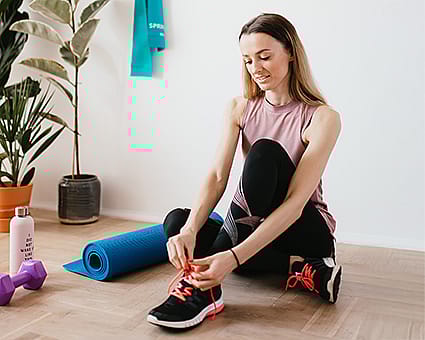
Strength training doesn’t always mean starting right away with heavy weights and advanced fitness equipment. In fact, if you’re just starting with fitness, you can perfectly train using your own body weight to build muscle strength and endurance.
Whether you have limited space, are looking for a budget-friendly solution, or simply want to discover the benefits of bodyweight training, the following 12 strength exercises at home are ideal to start or continue your fitness journey. And the best part is, you don’t need any weights or fitness equipment.
- Push-ups: Work on your chest, shoulders, and triceps.
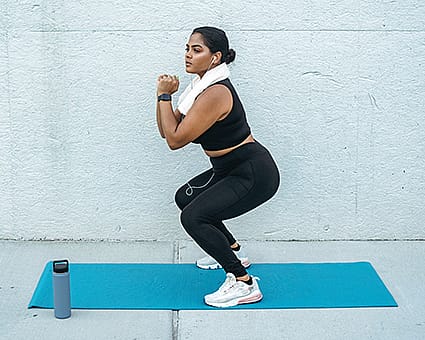
- Squats: Strengthen your thighs and glutes.
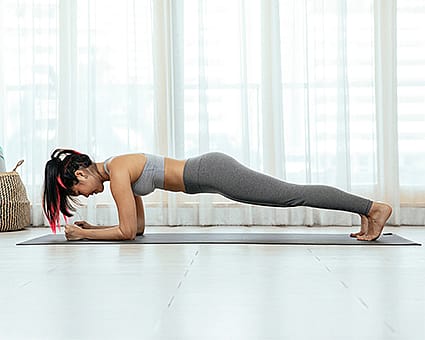
- Plank: Strengthen your core (abs).
- Lunges: Strengthen your thighs and glutes.
- Tricep dips: Work on your triceps.
- Burpees: A full-body workout.
- Mountain climbers: Cardio and core in one.
- Glute bridges: For tighter glutes.
- Side plank: For your obliques (side abs).
- Leg raises: Work on your lower abs.
- Superman: Strengthens your back muscles.
- Jumping jacks: Great for cardio and legs.
Later in this blog you can read how to incorporate these exercises into a training plan.
12 Strength Exercises at Home (with weights / equipment)
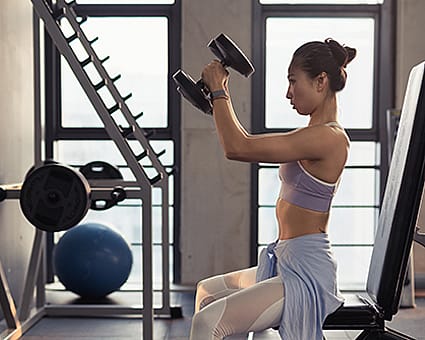
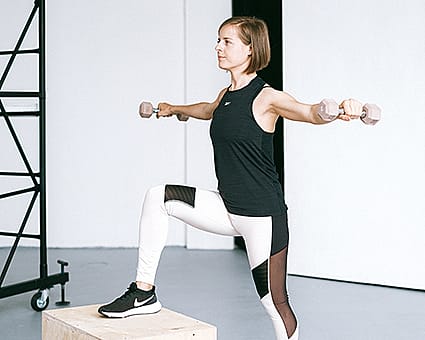
Do you notice that you’ve reached a point where training with just your body weight is no longer enough? Or have you been training for a while and feel it’s time to step it up? Then you can add strength exercises with weights and extra equipment to your workout routine. This way, you can get even more out of your workouts. By training with, for example, dumbbells, resistance bands, and a workout bench, you can perform other strength exercises that further improve your strength. There are countless exercises you can do to effectively target your desired muscle groups. The 12 exercises below are, in our opinion, ideal for doing at home and taking your strength to the next level.
- Dumbbell press: For your chest and shoulders.
- Dumbbell squats: Strengthen your legs.
- Resistance band rows: Work on your back.
- Kettlebell swings: For your core and legs.
- Dumbbell bicep curls: For your biceps.
- Leg press with resistance band: For your thighs.
- Dumbbell deadlift: For your back and legs.
- Dumbbell lunge: Strengthens your thighs.
- Kettlebell goblet squat: Total leg workout.
- Resistance band pull apart: For your upper back.
- Dumbbell overhead press: For your shoulders.
- Ab wheel rollout: Intense core workout.
Later in this blog you can read how to include these exercises in a training plan.
What do you need to start strength training at home?
To start strength training at home, the equipment you need depends on your specific training goals, budget, and available space. However, here’s a basic list of materials and fitness equipment for both exercises with and without weights:
For bodyweight training (calisthenics) (without weights):
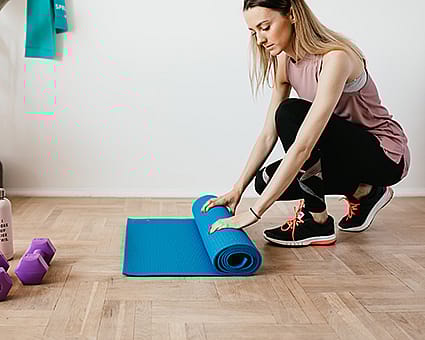
- Fitness mat: For exercises such as planks, push-ups, and other floor exercises.
- Resistance bands: These bands are highly versatile and can be used for resistance training and stretching.
For strength training with weights and equipment (depending on the exercise you want to do):
- Adjustable dumbbells: They save space and can be adjusted to different weight levels.
- Resistance bands: These provide resistance and are ideal for both strength training and mobility exercises.
- Barbell & weight plates: For exercises such as squats, deadlifts, and bench press. This does require more space and a solid surface.
- Workout bench: An adjustable workout bench offers variety for exercises like bench press, dumbbell rows, and more.
- Kettlebells: Suitable for both strength and conditioning exercises, e.g., squats.
- Parallettes: Useful for exercises such as L-sits, (tricep) dips, and certain push-up variations.
Additional materials:
- Jump rope: Excellent for cardio and warming up.
- Foam roller: Useful for muscle recovery and mobility exercises.
- Exercise ball: Can help with core exercises and improves stability and balance.
If you’re just starting out, you don’t need to buy all this equipment right away. Start with the basics and gradually expand as your strength progresses and your fitness goals become clearer. It’s important to ensure a safe training environment, especially when working with weights, to avoid injuries.
Strength equipment for home
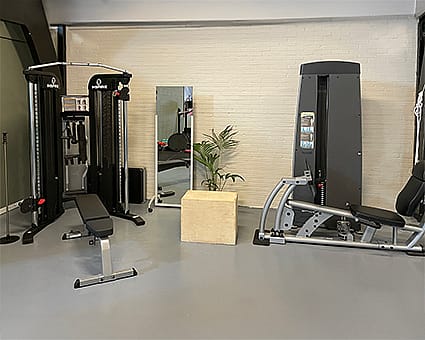
Do you want to take it a step further and expand your strength training even more? Then you can also opt for strength equipment such as a home gym / multigym. These strength stations can be seen as a mini gym where you can perform a huge variety of strength exercises. With a strength station, you can do many more exercises compared to calisthenics or strength training with dumbbells and a workout bench, allowing you to train and strengthen additional muscle groups. The Finnlo FT2 multigym, for example, offers the possibility to perform bench presses, leg curls, pull-ups, cable pulleys, and much more — giving you access to more than 75 different exercises with ease.
Create a training plan for home
To achieve the best results, it’s important to consistently perform certain strength exercises over a longer period and gradually increase the intensity. This ensures that your muscles are continuously challenged by the added weight, leading to growth and increased strength. You can create your own strength plan to determine which muscle groups you want to train or, if you know someone who does strength training, ask them for help in setting up your training plan. To give you an example, I have prepared two different plans for you:
Example plans for home strength training
Below are two training plans for three days per week, targeting different parts of your body. For example, train on Monday, Wednesday, and Friday. This also allows a rest day in between for your body. The first plan focuses on strength training without weights, and the second plan includes strength training with weights and equipment. Of course, you can swap exercises, remove some, or add others according to your preference.
Example plan: Strength training without gym equipment / weights
Day 1 - Upper body and core:
- Push-ups: 3 sets of 10-15 reps
- Tricep dips: 3 sets of 10-15 reps
- Plank: 3 sets of 30-60 seconds
- Side plank (both sides): 3 sets of 30 seconds per side
- Superman: 3 sets of 12 reps
- Burpees: 3 sets of 10 reps (for a cardio component)
Day 2 - Lower body:
- Squats: 3 sets of 15 reps
- Lunges: 3 sets of 12 reps per leg
- Glute bridges: 3 sets of 15 reps
- Jumping jacks: 3 sets of 30 seconds (for cardio and leg activation)
Day 3 - Full-body and cardio:
- Mountain climbers: 3 sets of 30 seconds
- Leg raises: 3 sets of 12 reps
- Burpees: 3 sets of 12 reps
- Push-ups: 3 sets of 10 reps
- Squats: 3 sets of 15 reps
Example plan: Strength training with weights and equipment
Day 1 - Upper body:
- Dumbbell press: 3 sets of 10-12 reps
- Dumbbell bicep curls: 3 sets of 12 reps
- Dumbbell overhead press: 3 sets of 10-12 reps
- Resistance band rows: 3 sets of 12 reps
- Resistance band pull apart: 3 sets of 15 reps
Day 2 - Lower body:
- Dumbbell squats: 3 sets of 15 reps
- Kettlebell swings: 3 sets of 15 reps
- Dumbbell lunge: 3 sets of 10 reps per leg
- Kettlebell goblet squat: 3 sets of 12 reps
- Leg press with resistance band: 3 sets of 12 reps
Day 3 - Full-body:
- Dumbbell deadlift: 3 sets of 10-12 reps
- Ab wheel rollout: 3 sets of 10 reps
- Dumbbell press: 3 sets of 10 reps
- Kettlebell swings: 3 sets of 15 reps
- Resistance band rows: 3 sets of 12 reps
For both plans: Begin each session with a proper 5-10 minute warm-up, including stretching. Finish with a 5-10 minute cool-down. Adjust the number of repetitions and sets to your own level and ensure your body gets sufficient rest between workouts to recover.
Home strength training: with or without weights?
If you want to work on your strength and muscle mass at home, you can choose to start without or with weights. If you are just beginning strength training, you don’t need large fitness equipment or a gym right away. Strength training is often associated with weights such as dumbbells, kettlebells, and barbells, but that is not necessarily required at the beginning.
If you start without weights, this is also called bodyweight training or calisthenics. This is a form of exercise where you primarily use your own body weight as resistance. For beginners, this form of strength training is an excellent starting point for training at home.
Both methods have their own advantages and disadvantages; let’s take a closer look:
Home strength training without weights and equipment
Advantages:
- Accessibility: You don’t need specific fitness equipment to get started.
- Cost-saving: No initial investment in weights or equipment is required.
- Versatility: There are countless bodyweight exercises that target all muscle groups.
- Lower risk of injury: Without heavy weights, there is often less risk of certain types of injuries, such as those caused by overloading.
Limitations:
- Limited progressive overload: Over time, it can be harder to make exercises more challenging without adding extra weight.
- Possible plateaus: Your muscles may get used to the same exercises, slowing progress.
Home strength training with weights and equipment
Advantages:
- Progressive overload: With weights, you can easily increase resistance as you get stronger.
- Variability: You can add weights to countless strength exercises, creating variation and differentiation in your training plan.
- Targeted: You can more effectively isolate and train specific muscle groups with the help of weights.
- Faster muscle growth: For some people, adding weights can lead to faster hypertrophy (muscle growth).
Limitations:
- Cost: An initial investment is required to buy weights or fitness equipment.
- Storage space: Weights and fitness equipment take up space in your home.
- Increased injury risk: If you train incorrectly or use weights that are too heavy without proper technique, the risk of injury increases.
Whether you choose strength training with or without weights, the most important factors are consistency, proper technique, and a balanced training program. Beginners can achieve excellent results with bodyweight exercises, while those looking to take their training to the next level can benefit from adding weights to their routine. The choice depends on your personal goals, budget, space, and preferences.
Conclusion
Doing strength training at home offers you plenty of advantages. Not only does it save you valuable time, it also gives you the freedom to train in familiar surroundings and at your own pace. These strength workouts can be done both with and without equipment.
With strength training without weights, the focus is mainly on exercises that use your own body weight as resistance. Think of push-ups, which work your chest, shoulders and triceps, and squats for your thighs and glutes. The big advantage is that you need little to no extra equipment, which makes it easy to get started.
However, for those who want to make their training more intense or more varied, there is also a wide range of options for strength training with weights. Think of exercises with dumbbells, such as the dumbbell press, or exercises with resistance bands and kettlebells. This form of strength training at home adds extra challenge and progression.
To train at home in the best possible way, it is useful to have a few basic items at hand. These can range from a simple fitness mat and resistance bands to more advanced equipment such as dumbbells and kettlebells. For those who really want to take it a step further, there are strength machines for home use such as home gyms and multi gyms. These allow you to perform a very wide range of strength exercises on a single compact machine.
Would you like to start strength training at home and are you looking for advice or additional information?
Our fitness specialists will be happy to help you with any questions you have about what you need. That way you can make a well-informed choice and get the most out of your strength exercises. You can contact our fitness specialists on +31 85 773 00 57, send an e-mail or visit our showroom in Volkel, the Netherlands.