


12 tips for buying an indoor cycle: what to look for
Updated: 6 November 2026
Short answer: a good indoor cycle for home has a quiet magnetic braking system, a flywheel of around 15 to 20 kg, a saddle and handlebar you can adjust in height and depth, and a maximum user weight at least 20 kilos above your own weight. A good indoor cycle for home costs around € 700 to € 1,600; for intensive or professional use, choose a model from around € 2,000.
An indoor cycle is the way to do intensive cycling at home. You train your fitness, your legs and your glutes, and you don't depend on the weather or the opening hours of the gym. Whether you are a keen road cyclist or simply want to get fitter: on an indoor cycle you set the pace.
But what should you look for when buying an indoor cycle? There are many models, from simple starter bikes to indoor cycles with a touchscreen and apps. In this blog you will find 12 tips, from the pedal system and resistance to the adjustment and your budget. For each tip, we show which indoor cycles we recommend. Want to compare all models straight away? Then take a look at our indoor cycles or the indoor cycles for home.
Our recommendations for home

- V-belt drive
- Felt brake (Direct contact)
- Flywheel mass: approx. 18 kg
Order before 5:00 PM, delivered tomorrow

- V-belt drive
- Felt brake (Direct contact)
- Flywheel mass: approx. 22 kg
Order before 5:00 PM, delivered tomorrow

- V-belt drive
- Magnetic brake
- Flywheel mass: approx. 18 kg
Order before 5:00 PM, delivered tomorrow

- V-belt drive
- Felt brake (Direct contact)
- Flywheel mass: approx. 20 kg
Order before 5:00 PM, delivered tomorrow
In this blog
- Which indoor cycle suits you?
- Why choose an indoor cycle?
- Tip 1: Decide where and how often you will use the indoor cycle
- Tip 2: Choose a fixed gear or freewheel
- Tip 3: Choose the right braking system
- Tip 4: Look at the flywheel: weight and position
- Tip 5: Look at the frame, user weight and dimensions
- Tip 6: Pay attention to the Q-factor
- Tip 7: Adjust the saddle and handlebar properly
- Tip 8: Choose a console and apps that suit you
- Tip 9: SPD pedals or toe cages?
- Tip 10: Set your budget
- Which indoor cycle brands are there?
- Tip 11: Choose the right accessories
- Tip 12: Try out the indoor cycle and have it installed
- Frequently asked questions about buying an indoor cycle
- Conclusion
Which indoor cycle suits you?
Why choose an indoor cycle?
On an indoor cycle you sit just like on a road bike: sporty, leaning slightly forward, with a racing saddle and a solid flywheel. This makes every pedal stroke feel smooth and realistic, and you can also cycle standing up, just like climbing a hill. That makes an indoor cycle ideal for intensive workouts, interval training and indoor cycling classes.
- Intensive training: you build fitness and endurance quickly.
- Legs, glutes and core: you train your lower body and your core at the same time.
- Kind to your joints: cycling puts much less strain on your knees and ankles than running.
- Train any time: whatever the weather, whenever it suits you.
Torn between an indoor cycle and an exercise bike? On an exercise bike you sit upright and comfortably, on an indoor cycle in a sporty position. Read more in our blog about the differences between an exercise bike and an indoor cycle.
Prefer to ride calmly and upright? Then an exercise bike may suit you better.
Tip 1: Decide where and how often you will use the indoor cycle
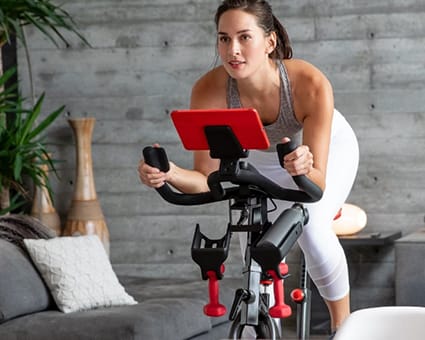
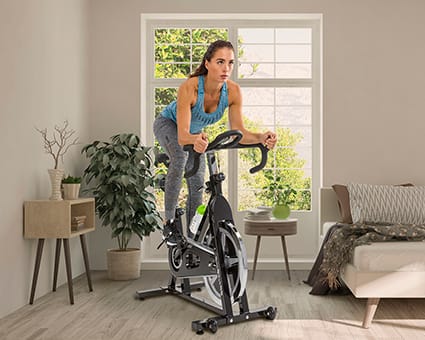
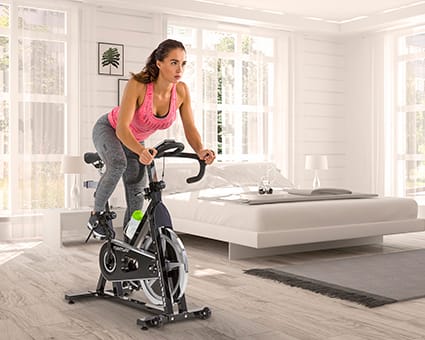
Start with the question of where and how often you will cycle. For home, you usually want an indoor cycle that is compact and quiet, with transport wheels so you can move it easily. Many home models can be connected to apps, so your workouts stay varied. Take a look at our indoor cycles for home.
In a gym, hotel or physiotherapy practice, an indoor cycle is used much more intensively, often by several people a day. Then it is all about a heavy frame, low-maintenance parts and a bike you can quickly set up for every user. Take a look at our indoor cycles for professional use.
Setting up a gym or hotel gym? Then choose a professional indoor cycle built for intensive daily use.


Tip 2: Choose a fixed gear or freewheel
The pedal system determines what the pedals do when you stop pedalling. There are two types:
- Fixed gear: the pedals are directly connected to the flywheel. As long as the flywheel turns, the pedals keep turning. Your legs keep moving, which gives a smooth, intensive workout. This is the classic system of indoor cycles and ideal for indoor cycling classes in which you alternate between sitting and standing. To stop, you use the emergency brake or turn the resistance up high.
- Freewheel: the pedals stop as soon as you stop pedalling, just like on a road bike. The flywheel keeps turning. This feels familiar to road cyclists and is pleasant during long endurance rides.
For most home users and indoor cycling fans, a fixed gear is the best choice. Want to train as if you are on your road bike? Then look for a model with a freewheel. In doubt? Ask our specialists, because not every manufacturer clearly states the pedal system.
Tip 3: Choose the right braking system
The braking system controls the resistance, and therefore how hard cycling feels. There are three types:
- Felt brake pads: a pad presses against the flywheel. Affordable, but the pads wear and need replacing from time to time. You see this system less and less.
- Manual magnetic: magnets slow the flywheel down without touching it. You adjust the resistance with a knob or lever. Quiet, smooth and maintenance-free. On the Schwinn 800IC you can even choose from 100 resistance levels.
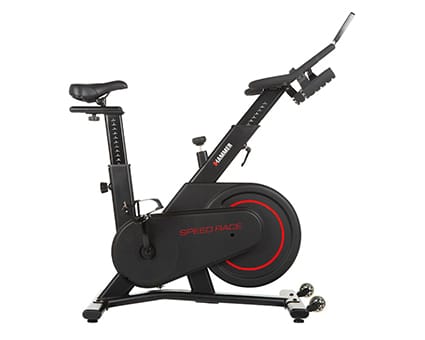
- Electronic (computer-controlled): you set the resistance via the console or an app, and training programmes or apps such as Zwift adjust it automatically. For example the Hammer Speed Race X and the Flow Fitness Perform S2i with 32 levels.
For home use, a magnetic braking system is almost always the best choice: it is quiet and needs no attention. If you like training with apps that adjust the resistance automatically, choose electronic resistance.
Tip 4: Look at the flywheel: weight and position
The flywheel ensures a smooth, round pedal stroke. It used to be: the heavier, the better. Today that matters less, because manufacturers cleverly move the weight to the outer edge of the flywheel. This means a lighter flywheel can still feel smooth. As a guideline, a flywheel of around 15 to 20 kg feels pleasant for home use. The indoor cycles we recommend have a flywheel of 13 to 22 kg.
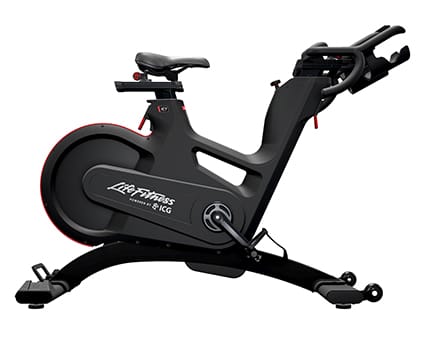
Also look at the position of the flywheel. On most indoor cycles it is at the front. On some more premium models it is at the back, such as on the Life Fitness IC7. The advantage: sweat does not drip onto the flywheel, so it is less likely to rust. An indoor cycle with a rear flywheel is usually a little longer.
Tip 5: Look at the frame, user weight and dimensions
A sturdy frame makes sure your indoor cycle does not wobble, even when you sprint standing up. The heavier and more robust the frame, the more stable the bike. With adjustable feet you can level the bike, even on an uneven floor.
Choose an indoor cycle that can carry at least 20 kilos more than your own weight. If you weigh 100 kilos, choose a bike for at least 120 kilos. Most indoor cycles for home can handle users up to 130 to 150 kilos.
Indoor cycles are usually around 110 to 155 cm long and 50 to 80 cm wide. Keep at least 50 cm of free space around the bike, so you can easily get on and off. Short on space? Then the Hammer Speed Race X is interesting: you can fold it and store it compactly.
Tip 6: Pay attention to the Q-factor
The Q-factor is the distance between the outer sides of the pedals. A Q-factor similar to that of a road bike, around 150 to 170 mm, feels the most natural. Your knees then stay nicely above your feet, and your hips, knees and ankles are put under less strain. If the Q-factor is too wide, your legs are pushed outwards; if it is too narrow, the movement feels cramped.
Not every manufacturer states the Q-factor. The Life Fitness IC6, for example, has a Q-factor of 155 mm. In doubt? Then try the bike in our showroom.
Tip 7: Adjust the saddle and handlebar properly
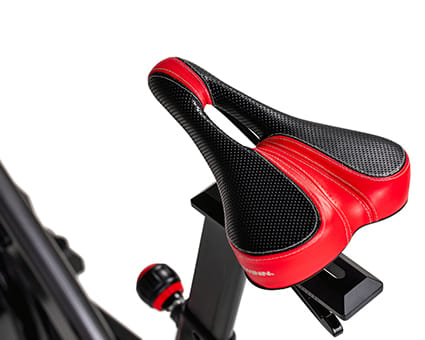
A good riding position prevents problems with your knees, back and neck. So choose an indoor cycle on which you can adjust both the saddle and the handlebar in height and depth. That way you set up the bike exactly for your height. Do you have a road bike? Then copy the measurements of your road bike to your indoor cycle.
Most indoor cycles have a racing saddle. If you find it too hard, you can often replace it with a standard bike saddle or a more comfortable saddle. A multi-grip handlebar gives you different hand positions, so you can alternate between riding upright and a sporty position. A bottle holder and a tablet holder are also handy.
Tip 8: Choose a console and apps that suit you
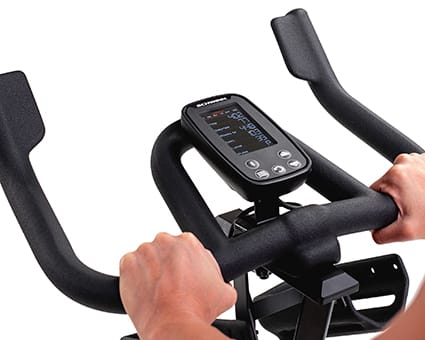
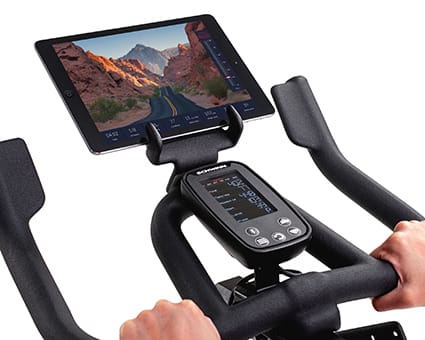
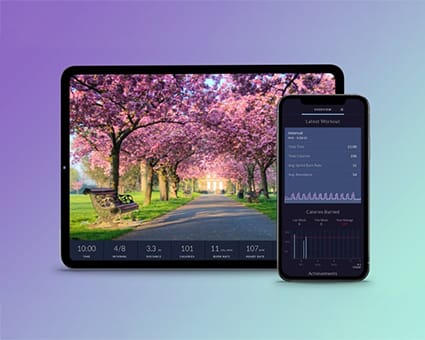
A console shows your training data, such as time, speed, distance, revolutions per minute, calories and heart rate. On some models you also see your power in watts, so you can train very precisely.
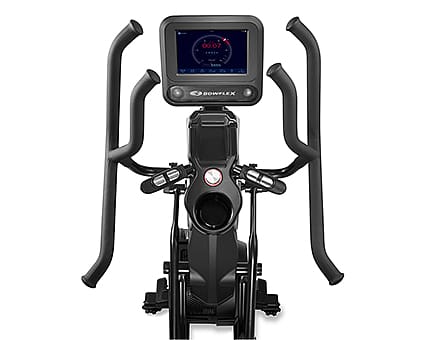
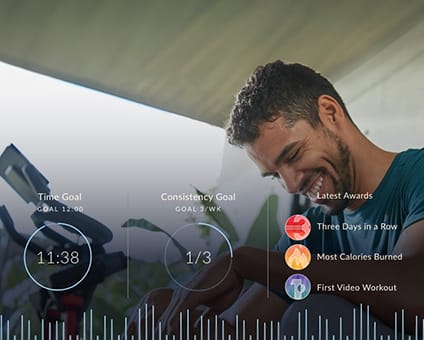
With Bluetooth or ANT+ you connect the bike to apps such as Zwift, Kinomap or JRNY. Then you cycle virtually through mountains and cities, ride along with other cyclists or follow live classes. That makes training much more varied. Some indoor cycles even have a large touchscreen, such as the Hammer HyRace SR with a 10.1 inch screen.
Want to train by heart rate? Then use a chest strap, such as the Toorx heart rate chest strap.

Recommendations for training with apps
- V-belt drive
- Magnetic brake
- Flywheel mass: approx. 18 kg
Order before 5:00 PM, delivered tomorrow

- V-belt drive
- Flywheel mass: 15 kg
- Electromagnetic brake
Order before 5:00 PM, delivered tomorrow
- V-belt drive
- Felt brake (Direct contact)
- Flywheel mass: approx. 20 kg
Order before 5:00 PM, delivered tomorrow
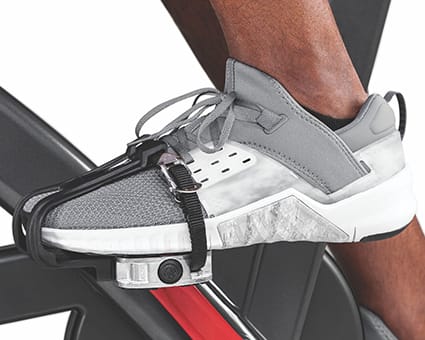
Tip 9: SPD pedals or toe cages?
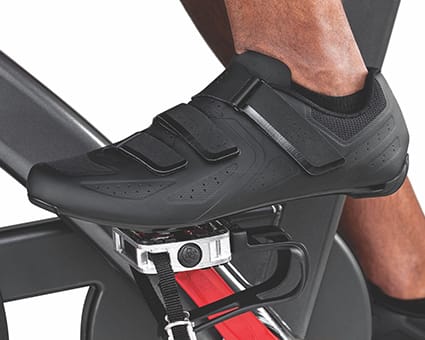
- SPD pedals: you clip special cycling shoes with SPD cleats onto the pedal. Your foot is held firmly, so you also put power into pulling the pedal up. Ideal for road cyclists and intensive sprints.
- Toe cages: you slide the front of your normal sports shoe into the cage. You don't need special shoes, so this is an easy way to start.
Most indoor cycles have combination pedals: an SPD clip on one side, a toe cage on the other. So you choose what you prefer.
Tip 10: Set your budget
Your budget largely determines what you get. Roughly, there are three price ranges:
Entry level, around € 700 to € 1,000
Fine for cycling a few times a week, with magnetic resistance, a solid flywheel and often SPD pedals. The Schwinn 700IC, for example, has an 18 kg flywheel and dual SPD pedals, and the Hammer Speed Race X has electronic resistance and apps.
Entry-level recommendations
- V-belt drive
- Felt brake (Direct contact)
- Flywheel mass: approx. 18 kg
Order before 5:00 PM, delivered tomorrow
- V-belt drive
- Felt brake (Direct contact)
- Flywheel mass: approx. 22 kg
Order before 5:00 PM, delivered tomorrow

- V-belt drive
- Magnetic brake
- Flywheel mass: approx. 13 kg
Order before 5:00 PM, delivered tomorrow
Mid-range, around € 1,000 to € 1,600
More resistance levels, apps, a larger screen and often a higher maximum user weight. For example the Schwinn 800IC, our best-selling indoor cycle, or the Tunturi Platinum SB20 with a 22 kg flywheel.
Mid-range recommendations
- V-belt drive
- Magnetic brake
- Flywheel mass: approx. 18 kg
Order before 5:00 PM, delivered tomorrow
- V-belt drive
- Flywheel mass: 15 kg
- Electromagnetic brake
Order before 5:00 PM, delivered tomorrow

- V-belt drive
- Induction brake (ergometer)
- Flywheel mass: approx. 20 kg
Order before 5:00 PM, delivered tomorrow
Premium and professional, from around € 2,000
Built for intensive use, with a heavy frame and high-quality parts. For example the Life Fitness IC3 and IC6, which you also see in gyms, or the NOHrD Bike V2 with a solid oak frame and a maximum user weight of 250 kg.
Premium indoor cycles

- V-belt drive
- Felt brake (Direct contact)
- Flywheel mass: approx. 18 kg
Order before 5:00 PM, delivered tomorrow

- V-belt drive
- Magnetic brake
- Ergometer (Watt)
Delivery within 2 – 4 business days

- Flywheel in oil tank
- Improved ergonomics
- Very quiet system
Order before 5:00 PM, delivered tomorrow
Looking for an extra sharp price? Then also take a look at our second-hand indoor cycles: checked by our technicians and with a warranty.
Which indoor cycle brands are there?
At Fitness24 you will find indoor cycles from brands such as Schwinn, Hammer, Flow Fitness, Tunturi, Horizon and NOHrD for home, and from premium and professional brands such as Life Fitness, Technogym and Keiser. Each brand has its own riding position and strengths. Schwinn, for example, is known for its sporty indoor cycles with apps, Life Fitness for its robust bikes for gyms and NOHrD for its wooden design.
Tip 11: Choose the right accessories
Place a protective mat under your indoor cycle. It protects your floor against sweat and scratches and dampens vibrations and noise. Choose a mat that is slightly larger than the bike.
With a heart rate strap you measure your heart rate accurately, so you can train in the right heart rate zone, for example for fat burning or your fitness. And with a tablet holder you can watch a series or follow an app while cycling. View all indoor cycle accessories.
Useful accessories

- Protects the floor
- Length 100 to 127 cm
- Reduces noise
Order before 5:00 PM, delivered tomorrow

- Heart rate measurement
- Bluetooth 4.0 devices
- Chest strap / Digital sensor
Order before 5:00 PM, delivered tomorrow

- Device confirmation
- Indoor cycle console
- Tablet holder
Order before 5:00 PM, delivered tomorrow
Tip 12: Try out the indoor cycle and have it installed
Riding position, Q-factor and the feel of the flywheel are best experienced when you sit on the bike yourself. Many indoor cycles from our webshop are on display in our showroom in Volkel, where our specialists give you honest advice.
Prefer not to assemble it yourself? Then choose delivery and installation. Our technicians assemble the bike, put it in the place you want and check that everything works properly. If you prefer to assemble it yourself, you get clear instructions.

Frequently asked questions about buying an indoor cycle
What should I look for when buying an indoor cycle?
Above all, look at the pedal system, the braking system, the flywheel, the adjustment options of the saddle and handlebar, the maximum user weight and your budget. For home use, quiet magnetic resistance is the best choice.
What is better: a fixed gear or a freewheel?
A fixed gear is the classic system of indoor cycles and ideal for indoor cycling workouts and intervals. A freewheel feels like a road bike and is pleasant for road cyclists doing long endurance rides.
How heavy should the flywheel of an indoor cycle be?
For home use, a flywheel of around 15 to 20 kg feels pleasant. The weight matters less than it used to, because modern flywheels cleverly have their weight at the outer edge.
How much does a good indoor cycle cost?
A good indoor cycle for home costs around € 700 to € 1,600. For intensive or professional use, you pay from around € 2,000.
Can you lose weight with an indoor cycle?
Yes. Indoor cycling is an intensive workout in which you burn a lot of calories. Cycle regularly, for example three to five times a week for 30 to 45 minutes, alternate easy rides with intervals and combine this with healthy eating.
Indoor cycle or exercise bike: which suits you better?
An indoor cycle suits intensive and sporty cycling better. An exercise bike is more comfortable and better suited if you want to cycle at an easy pace or have less mobility. Take a look at our blog about the differences between an exercise bike and an indoor cycle.
Conclusion
You choose a good indoor cycle based on how and where you cycle, your height and weight, and your budget. Above all, look for a quiet magnetic braking system, a smooth flywheel, a saddle and handlebar that you can adjust properly and a maximum user weight with enough margin. If you like cycling with apps, choose a model with Bluetooth or a touchscreen.
View all indoor cycles or visit our showroom to try them yourself.
Need help choosing?
Our fitness specialists are happy to help you choose the right indoor cycle for your situation. Call +31 85 773 00 57, send an email or visit our showroom in Volkel, the Netherlands.
Also worth reading


