
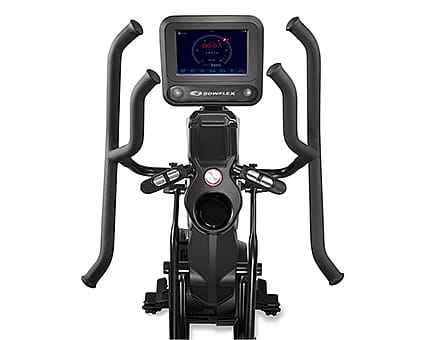


Build and set up your own home gym?
Build your own home gym? Create your ultimate fitness paradise (The complete guide)
You’ve already taken the first, and perhaps most important, step – exploring how to improve your health and fitness. Most likely, one of the areas you’ve come across is fitness. That’s already a win – well done!
Fitness is a fun and versatile way to work on your health, whether you want to train for more strength, muscle mass, endurance, or weight loss. Everything is possible thanks to the variety of fitness training.
Every (dedicated) fitness enthusiast probably dreams of having their own home gym. Never again having to ask at the gym “How many sets do you have left?” or “Are you almost done?” – wonderful, right? No more waiting for the right machine, no walking through wind and rain to the gym, and no trainer closing up while you’re still working on your last sets. Just train how and when you want. Sounds good? Then it might be time to build your own home gym.
A home gym? Absolutely! With a home gym, you bring your own fitness studio into your house – with the equipment and gear that match your goals and needs. This way, you can get even more out of your workouts, whether it’s strength training or cardio.
After reading this complete guide, you’ll know exactly which fitness equipment and gear you need to create your ultimate fitness paradise at home.
In this guide to your ultimate home gym:
- Why choose a home gym instead of the gym?
- What are the benefits of a home gym?
- What could be the possible drawbacks of a home gym?
- Define your fitness goals
- Decide which space you want to use for your home gym
- Possible spaces for your home gym
- Create a personal and pleasant atmosphere in your home gym
- Define your budget
- What do you need to set up your home gym?
- The minimum essentials for your home gym
- Fitness machines for targeted workouts
- Various example gyms
- Maintaining your home gym
- Home gym inspirations
- Save money? Set up your fitness space with second-hand equipment
- Build your home gym yourself or have it done?
- Conclusion
Why choose a home gym instead of the gym?
If you want to start working out, there are different options, but the most common ones are either going to the gym or training comfortably from home. But why would you choose a home gym instead of the gym? Here, by home gym we mean a fitness space in your house; there are also machines called “home gyms,” but we’ll cover those later. Let’s take a closer look at the pros and cons:
What are the benefits of a home gym?
Having a home gym brings several benefits, such as:
- Save time: Your most valuable asset is time. Since you no longer need to travel to the gym, you can spend that extra time on other activities.
- Privacy: Maybe you don’t like it when the gym is crowded. With a home gym, you can train at home in peace and comfort.
- Completely tailored to your needs: You can choose your own equipment and gear, ensuring everything suits you perfectly.
- Cost savings: The initial investment is higher than a gym membership, but in the long run, a home gym is always cheaper.
- Train whenever you want: Never wait again for the machine you need. This makes your training more efficient and saves you time.
- Hygiene: You probably know it – the previous user leaves a sweaty seat behind. No thanks! With your own equipment, it’s much more hygienic, plus you can clean it as often as you like.
- Your own music and atmosphere: Gym music is often not great ;). At home, you can create your own vibe, which boosts motivation and helps you reach your goals faster.
What could be the possible drawbacks of a home gym?
So, are there downsides to having a home gym too? Yes, there can be – it depends on how you look at it.
- The initial cost: If you want to set up a very complete home gym, the upfront cost is higher. But the great thing is you can build it step by step. Start with dumbbells and a bench, and later add a rowing machine or exercise bike. Over time, a home gym is cheaper than a membership.
- Required space: To equip a fitness room with different machines, you need enough space. In smaller homes, that can be tricky, but if you have a spare room or a large garage, it’s definitely worth it.
- Less social interaction: This is personal – some enjoy training with others around, while others prefer to train alone.
- Professional guidance: Some people like to receive instructions or coaching from a trainer. But both at the gym and at home, you’ll spend most of the time training independently.
Define your fitness goals
Before you get too excited selecting new equipment and gear, it’s important to define your fitness goal(s) and keep them in mind. For example, if your aim is muscle growth, a stationary bike won’t be the most effective tool, but a strength station will. To help you, we’ve listed some of the most common fitness goals with the equipment that fits them:
Fitness goal 1: Weight loss
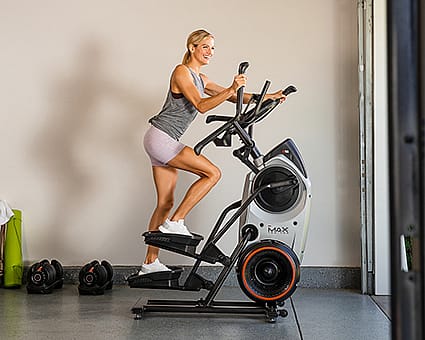
Weight loss happens mainly when you burn more calories than you consume. To lose weight, it’s key to exercise regularly (2–3 times per week) combined with a healthy diet. Cardiovascular exercises such as running, walking, and cycling are ideal. Helpful equipment includes: treadmills, exercise bikes, rowing machines, spin bikes and cross trainers.
Fitness goal 2: Muscle building and strength
To achieve muscle growth, focus on resistance training, progressive overload, and proper nutrition.
Resistance training challenges your muscles, increasing strength, endurance, and size. Progressive overload means gradually increasing weights, reps, or reducing rest times to force adaptation. Useful equipment includes dumbbells, barbells with weight plates, and larger machines like multi gyms, lat pulldown machines, power racks and much more.
Fitness goal 3: Flexibility & mobility
Flexibility and mobility are vital for overall fitness. Flexibility focuses on stretching muscles and tissues, while mobility is about moving joints freely without pain. Training both reduces injury risk and supports daily movement. Helpful tools include functional trainers, resistance bands, balance trainers and exercise balls.
Fitness goal 4: Improve overall health
You don’t have to pick one specific goal. You can simply train for better overall health, often a mix of cardio and strength training. Recommended equipment includes rowing machines, cross trainers, and multi gyms.
Decide which space to use for your home fitness gym
Have you defined your fitness goals? Then it’s time for the next step: considering where / in which space you could set up your home gym. Do you have a larger house with an extra room? That empty room could be a very good option. If space is more limited, setting up a full home gym can be more challenging, but it’s not impossible.
Depending on how extensive you want your home gym to be, it’s important to measure the available space and consider the equipment you plan to install. You need enough room to perform cardio and/or strength exercises without anything in the way. Here are some possible spaces for your home gym:
Possible spaces to place your home gym
In an extra room: If you have an extra room, such as a storage or guest room, consider clearing it out and setting it up with your new fitness equipment.
The garage: Do you have little or nothing in your garage? Then the garage is also a great option. Garages are often larger, allowing you to fit more fitness equipment. Additionally, you can train there quietly without disturbing anyone inside the house. Depending on your garage, it may be a bit colder there in the winter.
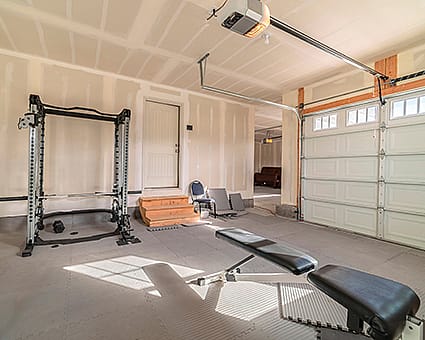
The basement: Does your house have a basement that you hardly use or only for storage? Then the basement can also be a great option. Consider clearing it out thoroughly, selling or removing old clutter, and then placing your new fitness equipment there so you can train peacefully.
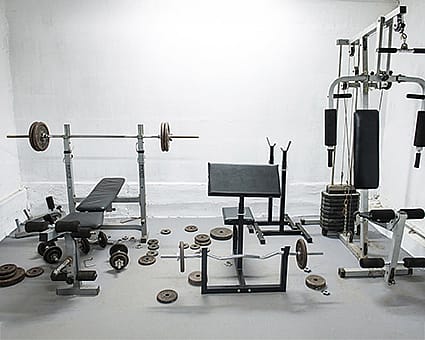
The attic: Do you have an attic with some free space? That could also be a perfect spot for your new home gym. Nothing will be in the way, and you can always train quietly.
The guest room: Maybe you have an extra room set up as a guest room. This room is probably not used every day. If there’s still extra space in the guest room, it’s also a great option to consider.
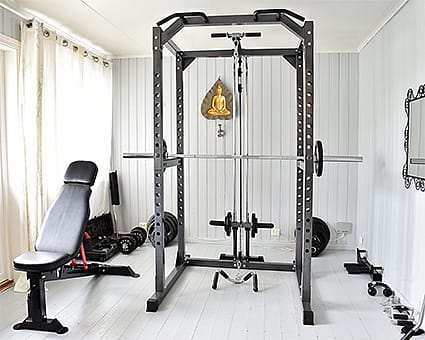
The garden shed: Do you prefer not to set up your new home gym inside the house, or is your garage already full? Then setting up a garden shed is another option. If you have a garden shed that you rarely use, you can convert it into your new home gym. If you have no space in your house at all, you could even consider placing a garden shed and installing your home gym there.
Create a personal and pleasant atmosphere in your home gym
Now that you have decided which space you could use for setting up your new home gym, you can start thinking about the design of your fitness room. It’s much nicer and more enjoyable to train in a beautiful space. Before you set up your new room with your fitness equipment, it’s best to prepare the space first. Otherwise, you might have to rearrange the equipment later, which isn’t very convenient.
Paint the room
While you’re at it, you can give your new fitness room a fresh coat of paint. It doesn’t need to be a masterpiece; you can keep it simple. For example, paint the room a fresh white, and avoid very dark colors. Color has a greater impact on your mood than often assumed. Use fresh and light colors for a pleasant atmosphere.
Ensure good lighting
Good lighting is essential for creating an energetic atmosphere in your home gym. Make sure plenty of natural light comes in, for example through windows. If you like to train in the evening or early morning, it’s also good to have sufficient artificial lighting. Make sure there are adjustable lights such as spotlights so you can train whenever you want.
Ensure proper ventilation
Good ventilation is important for maintaining a comfortable and healthy training environment. Fresh air helps regulate your body temperature and removes odors and humidity. If your fitness room has windows that can be opened, that’s a big plus. You might also consider ventilation openings, a fan, air purifier, or air conditioning system to maintain good air quality and circulation.
Train with your favorite music
Do you get more out of your workouts when music is playing? Then definitely keep doing it! Music can be a powerful motivator and help you maintain focus and energy. It also makes training much more fun. For example, install a sound system or connect your favorite Spotify playlist to a portable speaker. Want to go further? You can create customized playlists with different styles and tempos depending on your workouts.
Mount a TV / screen
Besides a music system, you can also mount a TV or screen. During workouts, you can watch your favorite programs, movies, or series. You can also play instructional videos to help improve your movements and get more out of your workouts. If you like tracking your training data such as heart rate, calories burned, distance covered, etc., you can often project this on your TV or screen via apps. Some higher-end fitness brands like Life Fitness or Matrix offer touchscreens where you can view your training data, series, or movies.
For extra motivation and atmosphere
Have you set specific fitness goals? Make sure to review them every day. This keeps them in sight and helps you stay focused. For example, create a visual representation (or have one made) and hang it on the wall in your gym, or put up inspiring quotes or posters that give you extra energy. Another fun idea is to track your progress in a chart to easily see if you’re on track.
Determine your budget
Have you defined your fitness goals and chosen a nice space for your new home gym? The next step is your budget. You can make your home gym as extensive as you want, but setting it up doesn’t have to be expensive.
If you want to do strength training, you can consider which exercises you want to do and what fitness equipment and materials you will need. If you are just starting out, a good set of (adjustable) dumbbells and a weight bench may already be enough. If you are more advanced, you could also go for a full power station.
If your budget is limited or you simply don’t want to buy brand new equipment, you can also choose second-hand machines. We regularly offer refurbished equipment in our collection such as treadmills, rowers, exercise bikes, etc., all serviced and with warranty. This way you can enjoy them for many years while saving on the purchase price.
If you want a more extensive gym, you can gradually expand it until you have your dream home gym. For example, start with dumbbells, a weight bench, and a rowing machine, and later add a cross trainer or power station.
What you need to set up your home gym
Now that you have defined your fitness goals, chosen a space, and set your budget, you can look at which fitness equipment and materials best suit your training.
Minimum equipment needed for your home gym
Although you can make your home gym as extensive as you want, there are certain fitness tools that belong to the basic setup of every home gym, namely:
-
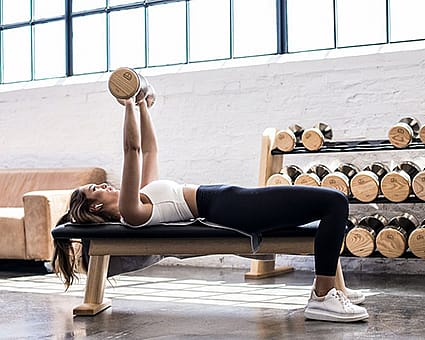
A good set of dumbbells / weights (or adjustable dumbbells)
Dumbbells are one of the oldest ways to train your muscle strength. The ancient Greeks and Romans already used dumbbells. With dumbbells, you can train very variably. For example, you can do biceps curls, triceps extensions, shoulder presses, bench presses, squats, lunges, and many more exercises. Ideal for developing muscle balance and stability because you can train each arm independently.
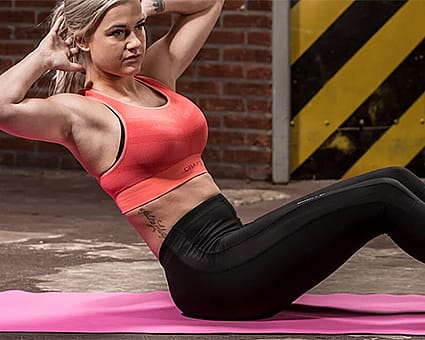
A fitness mat for the floor
Place a fitness mat on the floor so you can perform various exercises on it and train more comfortably. It improves your stability and comfort during workouts. It also provides hygiene and protects your body from the hard floor.
-
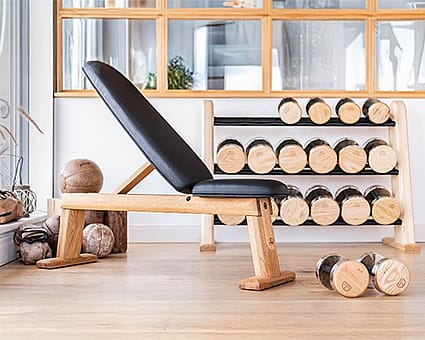
A good weight bench
With a good weight bench you can significantly expand your strength training. The purpose of the fitness bench is to provide proper support to your body when performing certain strength exercises. Think of bench presses, dumbbell flyes, shoulder presses, etc. If you opt for an adjustable weight bench, you gain access to even more exercises compared to a flat bench.
-
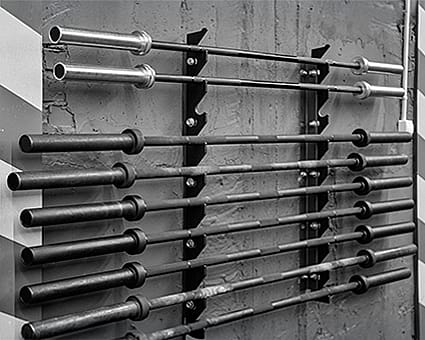
Olympic (or curved) barbell(s)
Barbells with individual weight plates are ideal if you want to increase your muscle mass. Both beginners and advanced fitness enthusiasts can use barbells. They are used, among other things, for bench presses, squats, deadlifts, bent-over rows, overhead presses, lunges, and much more.
-
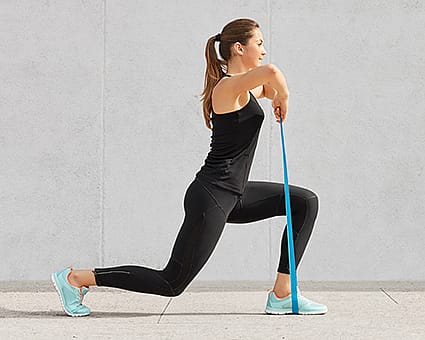
Resistance bands (elastics)
Resistance bands (or elastics) are versatile and can be used for strength training, muscle building, and rehabilitation, as well as for training flexibility and mobility. Resistance bands are available in different resistance levels, allowing you to start with a light resistance and gradually increase it.
Fitness equipment for targeted training
There are various types of fitness equipment available. Each of these devices has its own unique features and capabilities. Depending on your training goals, you can choose strength equipment or cardio machines.
Cardio equipment for your home gym
Cardio refers to exercises aimed at strengthening your heart and circulatory system. These exercises depend on the presence of oxygen to produce energy. Performing cardio exercises raises your heart rate and speeds up your breathing, thereby improving oxygen uptake and endurance. Some examples of cardio exercises are running, cycling, swimming, and rowing.
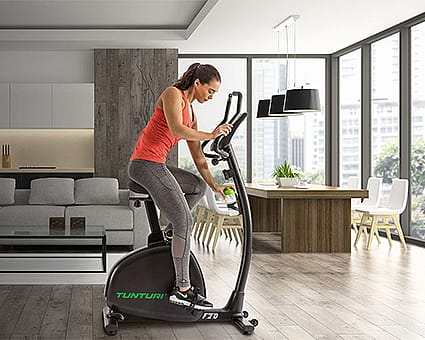
Exercise bikes
With an exercise bike, you can comfortably cycle indoors. Due to ease of use, effectiveness, and low impact on joints, they are among the most popular fitness devices for home use. They are often used to strengthen and train your leg muscles. Additionally, you can burn calories with them, which is beneficial for weight loss.
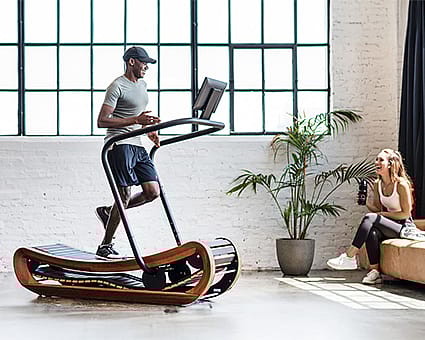
Treadmills
With a treadmill, you can simulate walking, jogging, or running. Ideal if you want to train at home (or rehabilitate) and don’t want to exercise outside in the cold or rain. Treadmills focus on training your leg muscles and also help you burn calories.
Rowing machines
Rowing machines are fitness machines that simulate the motion of rowing on water. The great thing about a rowing machine is that it provides a full-body workout, meaning you train your entire body. These are highly effective workouts with low impact on your joints, allowing you to burn calories and lose weight. They are excellent machines for improving endurance and strength.
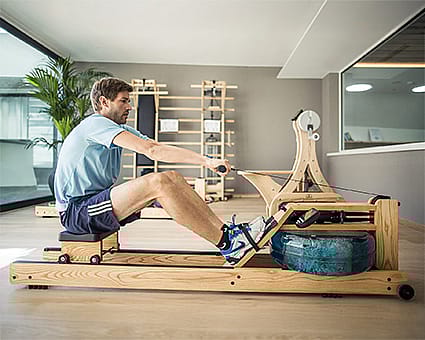
Rowing machines
Rowing machines are fitness machines that simulate the motion of rowing on water. The great thing about a rowing machine is that it provides a full-body workout, meaning you train your entire body. These are highly effective workouts with low impact on your joints, allowing you to burn calories and lose weight. They are excellent machines for improving endurance and strength.
Spinning bikes
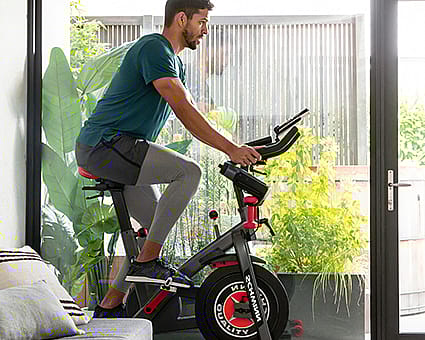
Indoor Cycle are similar to exercise bikes but slightly different. You still cycle with a indoor cycle, but these are specially designed for more intensive (almost racing) workouts. The focus of spinning bikes is on improving fitness, strengthening leg muscles, and burning calories.
Strength equipment for your home gym
Strength equipment is purely focused on building and strengthening your muscles. By training with resistance, you challenge the targeted muscle group, causing it to grow over time. Strength equipment allows you to train your strength in a safer way with proper support. Want to train specific muscles? This is also possible with strength equipment.
Strength stations
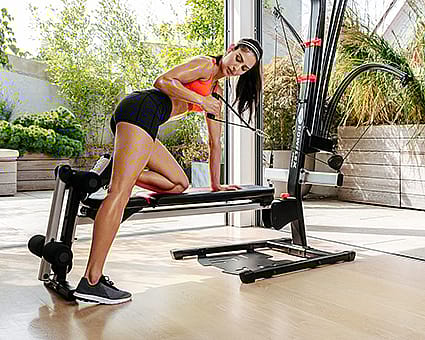
For home use, strength stations are ideal. We previously mentioned the “home gym.” Strength stations are often also called home gyms because you can compare them to a mini-gym. Strength stations (home gyms) provide the possibility to perform multiple strength exercises on a single machine. Therefore, strength stations are often compact and perfect if you want to save space.
Other equipment for your fitness room
The fitness equipment mentioned above is roughly the minimum that is nice to have in your home gym. In addition, there are various small items that are practical to have. These include:
-
Rubber mats
If you want to set up fitness equipment and train with weights, it’s best to cover your floor with rubber mats. Rubber mats protect your floor from scratches and holes (if you drop a weight), provide shock absorption, reduce noise, and have a non-slip function.
-
Storage for dumbbells / weight plates
If you use barbells instead of dumbbells, it’s convenient to store them neatly on a barbell rack. Even when training with a barbell with removable plates, you keep your home gym tidy by storing the plates. This ensures you never lose weights or trip over them while performing another exercise.
-
Mirrors
By hanging one or more mirrors on the wall, you can better monitor and adjust your posture and technique. Performing certain strength exercises with the wrong form can cause injuries or fail to target the correct muscles. Make sure mirrors are mounted high enough so that no weights accidentally roll against them and you can see your full body.
-
Safety
If you train alone at home, you likely don’t have a buddy or spotter to help in case something goes wrong. Therefore, it’s important to train safely and use safety tools such as brackets and hooks, weight collars, non-slip surfaces, adjustable equipment, and emergency stop systems (if available, preferred). Equipment maintenance is also important.
Maintaining your home gym
To enjoy your home gym for as long as possible, regular maintenance is important. The small amount of maintenance required ensures that you can enjoy your fitness equipment longer, train more safely, save money in the long term, and maintain a better resale/trade-in value. It is quite possible to perform minor maintenance on your equipment yourself. It is also possible to have maintenance performed periodically by our maintenance specialists.
Home gym inspirations
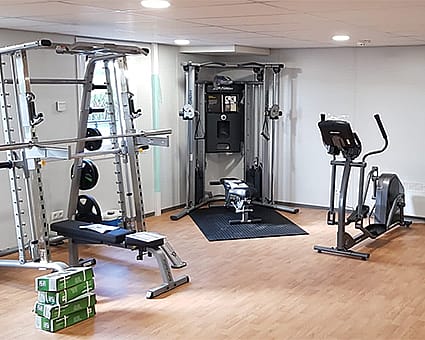
If you’re excited and want to create your own home gym, get inspired by different home gyms from people at home:
Saving? Set up your fitness room with second-hand equipment
Do you want to set up your new home gym but save money? Then you can also consider second-hand fitness equipment.
In our collection, we regularly have second-hand fitness machines such as treadmills, exercise bikes, elliptical trainers, rowing machines, spinning bikes and second-hand strength stations. These machines were traded in by customers when purchasing another fitness device. Our specialized technicians always thoroughly test the traded-in equipment for functionality. During testing, components such as pulleys, cables, and other moving parts are carefully inspected. Any worn parts are replaced. Additionally, you always receive a warranty on second-hand equipment, ensuring a fully functional machine that provides years of enjoyment at a very attractive price.
Do you want to assemble your home gym yourself or have it done?
Depending on the fitness equipment you order (or have ordered), some or all of the equipment may need to be assembled. Think, for example, of a strength station or a rowing machine. We offer different options: you can have your new equipment delivered in a box and assemble it yourself, or have it assembled by our specialized technicians. For some equipment, like strength machines, it is crucial that all pulleys are correctly installed and adjusted.
Conclusion
Creating your own home gym is a dream for many fitness enthusiasts that they are eager to realize. Setting up and organizing your home gym is a great investment in your health. With your own home gym, you can train at your own pace and whenever you want, all while avoiding the annoyances of a commercial gym. Since you can choose exactly which fitness equipment best matches your goals, such as weight loss, muscle building, flexibility, and mobility, you can fully tailor your workouts to your personal preferences, making your training targeted and effective.
When setting up your new home gym, it’s important to consider lighting, ventilation, music, and aesthetics, such as displaying your fitness goals on the wall. This ensures a pleasant and motivating training space. Also, remember to take your budget into account when selecting new fitness equipment and accessories, and note that you can also purchase second-hand fitness equipment from us at attractive prices.
If you train at home alone, it’s also important to pay attention to safety aspects, such as safety equipment and learning the proper technique.
All in all, having your own home gym allows you to work on your personal fitness goals in the comfort of your own home. By choosing the right fitness equipment and considering the factors discussed, you can create an effective and inspiring workout space, allowing you to achieve all your fitness goals and enjoy a healthier lifestyle.
Need help setting up your new home gym?
Do you want to set up a home gym but would like extra help and advice? Our fitness specialists are happy to assist you with any questions you may have. This way, you can make a well-informed decision and create your ultimate fitness space. You can contact our fitness specialists via +31(0)413-256800, send an email, or visit our showroom in Volkel, Netherlands.